
In Florida construction disputes, the contractor standard of care is the benchmark used to evaluate whether a contractor exercised the skill, care, and diligence expected of a reasonably prudent contractor. It is often at issue in contractor negligence claims, which can arise alongside allegations of construction defects and Florida Building Code violations. As discussed below, an alleged defect or code violation is not, by itself, a breach of the standard of care.
The standard applies to licensed Florida contractors, including general contractors, construction managers, and trade contractors. It can be at issue both in civil litigation and in administrative proceedings before the Construction Industry Licensing Board (CILB).
What Is the Contractor Standard of Care in Florida?
In construction practice, the standard of care is generally described as the level of skill, care, and diligence that a reasonably prudent contractor would exercise under similar circumstances. It is not outcome-driven. The question is whether the contractor’s actions were consistent with those of a reasonably prudent contractor performing similar work, under similar conditions, at the time the work was performed.
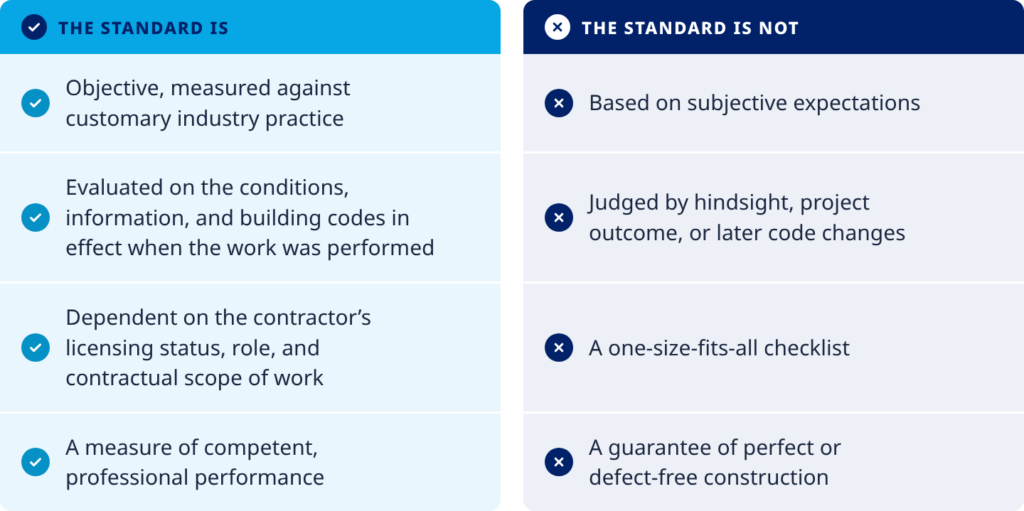
What the Standard Is and Is Not
As applied in expert analysis, the standard requires competent, professional performance rather than perfection:
How Experts Evaluate Contractor Performance
The scope of the standard depends on the contractor’s licensing status, contractual responsibilities, and role on the project. Within that scope, an expert evaluates the contractor’s conduct in light of the specific issues in the matter, considering the project documents, the conditions observed, and the industry practices and requirements that applied at the time the work was performed. Because the standard is role-dependent, the analysis often turns on who was responsible for what. In practice, responsibility for a single condition can rest with more than one party, such as the design professional and the contractor, depending on how the condition originated and who controlled that part of the work.
Code Violations and the Standard of Care
A building code violation and a breach of the standard of care are not the same thing. The standard of care measures the contractor’s conduct, not whether every component of a completed building is free of deviations. Construction projects involve many code-governed details, and many of them are designed by others or performed by licensed specialty trade contractors. The presence of a code deviation, standing alone, does not establish that the contractor failed to exercise reasonable care.
When a code violation is alleged, a standard of care analysis looks further. It considers whether the condition was within the contractor’s role and scope, whether customary supervision and quality control would have revealed it at the time, and what the record shows about how the work was performed and inspected. Depending on those facts, a deviation may or may not reflect a failure of reasonable care. An opinion on whether the standard was breached should rest on that analysis, not on the existence of the deviation alone.
Florida also provides a statutory cause of action for certain building code violations (Section 553.84, Florida Statutes). How it applies to any particular claim is a legal question for counsel.
The Role of Project Documentation
Project documentation is reviewed as evidence of performance, not as an independent duty. Contemporaneous records show how construction activities were planned, supervised, sequenced, and executed. Incomplete documentation does not, by itself, establish a deviation from the standard of care. It can, however, limit the ability of any party to verify what occurred and whether the work was consistent with accepted industry practices and contractual obligations.
The Regulatory Framework
Chapter 489, Florida Statutes, governs contractor licensing and is enforced by the CILB. Its requirements can provide context for a contractor’s role and responsibilities on a project. How they apply to a particular claim is a legal question for counsel.
How the Standard of Care Is Established in Litigation
In litigation, the contractor standard of care is typically established through qualified construction expert testimony. Experts compare observed conditions, project documentation, and witness testimony against accepted industry practices, applicable code requirements, and the contractor’s contractual responsibilities. Identifying a condition that departs from a code requirement or industry practice is where that analysis begins, not where it ends. A well-supported opinion on whether the standard was breached connects the condition to the conduct of the party responsible for that work.
Expert testimony in Florida is generally subject to the reliability requirements of Section 90.702, Florida Statutes, which call for testimony based on sufficient facts or data and on reliable principles and methods, reliably applied to the facts of the case. Miller Building Group’s evaluations follow documented, standards-based methods applied consistently to the facts of each matter.
Why the Standard of Care Matters
The contractor standard of care is an objective, role-dependent benchmark. It asks whether a contractor exercised the care a reasonably prudent contractor would have exercised, measured against the industry practices and requirements in effect when the work was performed. It does not ask whether the completed work is free of every defect or code deviation. Nor does the absence of a perfect outcome excuse conduct that fell short of reasonable care. Applying this framework consistently, to every party and every issue, is essential to an accurate evaluation of construction disputes.
Objective Evaluation of Contractor Performance
An objective, standards-based evaluation scan help clarify where contractor performance met the standard of care and where it may not have. Miller Building Group provides construction consulting and expert witness services for construction defect claims throughout Florida. Contact our team to discuss your project and request a proposal.
Disclaimer: This article is provided by Miller Building Group for general informational purposes only and does not constitute legal or engineering advice. Miller Building Group is not a law firm, and reading this article does not create an attorney-client, expert, or consulting relationship. How the standard of care applies depends on the specific facts, contract documents, and law governing each matter. Nothing in this article is an opinion on any particular project, party, or dispute, and it does not represent opinions that Miller Building Group or its personnel may offer in any specific matter after review of the relevant facts. Statutes, codes, and case law change over time. Consult a licensed Florida attorney regarding your specific situation.
